Unlocking the Pelvic Floor: Why Chronic Pelvic Pain Isn't "All in Your Head"
A tight (hypertonic) pelvic floor does not stay isolated in the pelvis—it alters how your entire body moves, breathes, and feels. Pelvic floor responds directly to stress. If you’re noticing deep, aching pelvic, rectal, or genital pain then you may have Prostatitis, Chronic Pelvic Pain Syndrome (CPPS) in men or Vulvodynia/Vaginismus, IC (interstitial cystitis) related pain in women.
Here is what many of my clients are rarely told: chronic pelvic pain is frequently a musculoskeletal issue. Your pelvic floor is very important to stabilize your core and to assist with bodily functions like peeing, pooping and having sex. All in all super important to your everyday wellbeing.
More often than not, the true culprit driving your discomfort is not an untreatable disease or a hidden bug, but a hypertonic—or chronically overactive—pelvic floor. The pelvis is the area of the body that reacts most to stress, it braces and contracts without us realizing and with this constant pulling the whole area tightens creating pain and tension.
The Muscle That Won't Let Go - Levator Ani
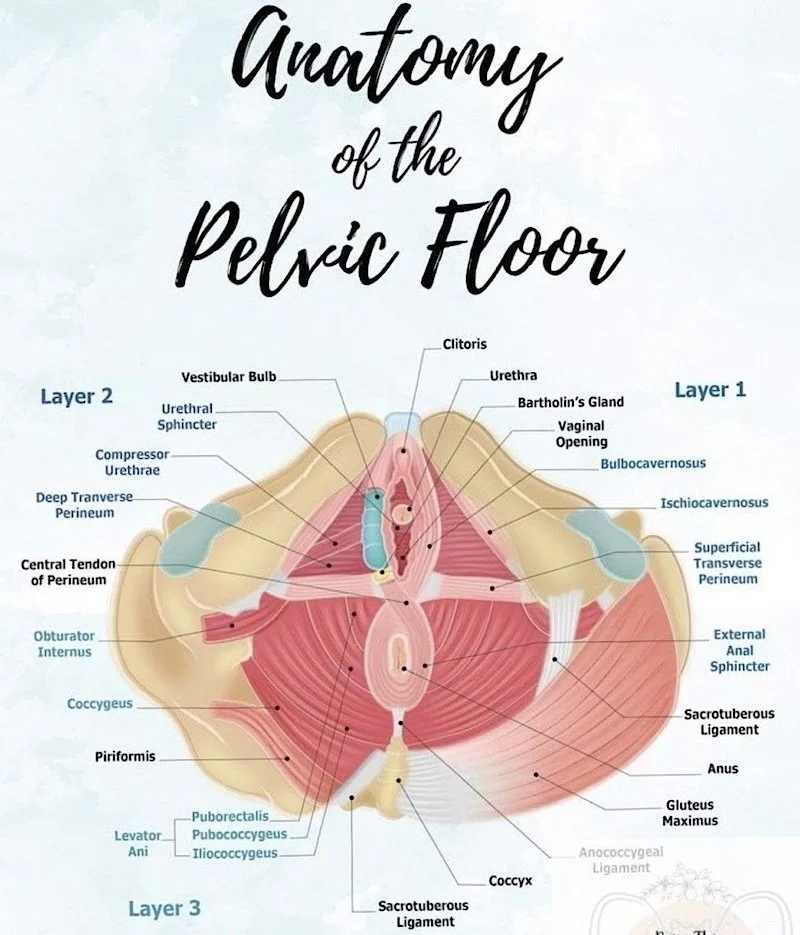
At the base of your pelvis sits the levator ani, your pelvic floor—comprising the puborectalis, pubococcygeus, and iliococcygeus, a broad muscle hammock stretching from your pubic bone to your tailbone. See figure below.
Under chronic stress, injury, or inflammation, this hammock enters a state of persistent spasm (hypertonicity). Taut bands of muscle trigger points—form and compress surrounding nerves like the pudendal nerve. The result?
Deep, aching pain in the pelvis, tailbone, or rectum
Burning, sharp sensations in the genitals
A "golf ball" sensation when sitting
Urinary urgency
The Body-Wide Ripple Effect
Because the pelvic floor acts as the physical center of your body, a locked pelvic floor alters how your entire system functions, moves, and breathes.
1. Postural Compensations & Guarding
When the levator ani contracts chronically, it exerts continuous mechanical traction on the pubic bone and tailbone. To protect this sensitive area, your body naturally adopts compensatory postures:
Pelvic Tilting: The pelvis often shifts into an anterior tilt (excessive arch in the lower back) or a posterior tilt (tucking the tailbone under), misaligning the lower back and sacroiliac (SI) joints.
Hip Guarding: The inner thighs (adductors) and deep hip rotators (obturator internus) clench involuntarily to stabilize the pelvic bowl, leading to persistent hip and groin stiffness.
2. Shallow Breathing and the Stress-Pain Loop
The pelvic floor and the respiratory diaphragm function as a coordinated pair. When you take a deep breath, your diaphragm drops, and your pelvic floor naturally expands and lengthens downward.
When you live with pain, this fluid movement stops. Pain triggers shallow chest breathing, cutting off the pelvic floor’s natural lengthening cycle and leaving it frozen in a shortened position. Because pelvic muscles are richly wired into the autonomic nervous system, anxiety and stress trigger immediate pelvic clenching—creating a self-reinforcing loop where stress tightens the muscles, and muscle pain heightens anxiety.
3. Loss of Intimacy and Function
Because the pelvic floor powers the mechanics of sexual function, chronic hypertonicity can severely impact intimate health:
In Women: Involuntary spasms drive dyspareunia (painful intercourse) or vaginismus, making penetration painful or impossible.
In Men: Muscle tightness around the base of the penis and prostate drives post-ejaculatory pain—a deep burning or aching after orgasm—and triggers stress-induced erectile difficulty.
How to break the cycle of chronic tension in the pelvis
Restoring health to a hypertonic floor requires a multi layered approach.
Diaphragmatic breathing: I give some useful breathwork techniques to allow the pelvis to expand and lengthen as the diaphragm opens and lifts. I show the difference between bracing and squeezing the pelvis on the inhale and exhale in order to create more space and awareness.
Abdominal and hip work: With gentle manipulation I release areas of holding in the abdominal wall, including around the top of the diaphragm which is often tight if your breath is predominantly shallow. I also gentle move the iliac crest and pelvic inlet. I will also do hip openers and release tight inner thigh muscles
External genital work: Using trigger point touch I work around the genitals, including releasing under the pubic bone, groin points, perineum and sit bones.
Internal release: For men I work intra rectally and for women intra vaginally. The Levator Ani can only be accessed internally. I work around the clock;
Anterior points: 10 to 2 o’clock targeting the levator ani: puborectalis, pubococcygeus (PC muscle) and moving towards the prostate in men and A-spot in women.
Lateral points: 3 to 9 o’clock, which targets the lateral pelvic walls and obturator internus (hip stabilization).
Posterior points: 5 to 7 o’clock, rectally I can tap the tailbone which gives almost immediate release to the pelvic floor. It also targets the posterior puborectalis and pubococcygeus. Helping the client to sit more comfortably again.
In conclusion
Your pelvic floor muscles learned to hold on to tension, which means it can also learn to let it go. With targeted manual release, diaphragmatic breathing, and compassionate care, I believe, you can break the pain cycle, restore nerve comfort, and regain more aliveness including intimate pleasure.
If you have any questions, comments, or interest in how I work - feel free to reach out.